
FORTY-SEVEN SECONDS


Madison Monroe watched the indie film the same way she processed crime scene photographs, without any expectations. This time though, she balanced a notepad on her knee. Her cup of precinct coffee chilled on a side table.
Borrowed Light was a 94 minutes Indie thriller. It had a limited festival release with one Sundance honorable mention. The filmmaker, 31-year-old named Eli Crane, prominently noted that Sundance mention in his press kit.
Maddie'd acquired a screener copy through the festival office after three phone calls and one carefully worded email to legal. She flagged it as relevant material for her case. The reason was yet to be determined.
She noted Crane's choices as she watched. The shallow depth of field. Every face smeared at the edges. A score that leaned too hard on the quiet moments. She wrote ~ overcorrects for sentimentality. ???
Forty-three minutes in, there was a transitional montage. Archival footage. Industrial, black-and-white, a factory floor from what looked like the late 1930s. Workers at machines. The camera hand-cranked. Figures moving in that faintly way of early film, as if the world had a different relationship with time back then.
Madison dropped her pen.
She didn't recall what followed. Her fingers dug into the armrest. Hard enough to leave indentations in the upholstery. Her notepad was now on the floor. The film in its final credits.
Fifty-one minutes of Borrowed Light were gone.
She sat very still. Careful not to move until she catelogued it all in her head. The room was the same. The coffee was cold. Her phone showed 11:47pm. She pressed play at 8:52. The math wasn't mathing.
When she closed her eyes, she saw James Reynolds standing in a room she had never been in. He was pointing at something. Off to her left in his patient and precise way. Something he'd already figured out and was waiting for her to catch up. He was wearing that navy blue jacket. The one they buried him in.
Maddie opened the case file and started reading about the film's reference to the open mystery the chief plopped on her desk. Three unrelated cases assigned to her because no one else could find the through-line. They didn't share a geography, a demographic profile, a criminal history, or a known associate.
Theodosia Payne, 44, wrongful conviction overturned after she provided impossible testimony in her own appeal. The information she'd named, a secondary wound angle, placement of a ceramic figure on the windowsill, the specific notation on a notepad found in the victim's kitchen, had never appeared in any document accessible to the public or to her defense team. Internal affairs investigated and found no leak. Theodosia claimed it a memory.
Schuyler Phillips, 38, financial analyst, $2.3 million in a single pharmaceutical trade at 9:47am. The data that moved the stock was not released until 3:12pm on the same day. The SEC had been working the case for four months and found no phone calls, no emails, no meetings, no contacts within the company or the research facility. Insider trading not evident.
Tanner Wash, 29, arrested on-site at a decommissioned records warehouse at 2:17am with a manila envelope and a set of picks. He bypassed a biometric lock on a room the building's current floor plan listed as a utility corridor. The room contained 31 filing cabinets from a defunct private security contractor. It was last accessed 1994. He'd gone directly to the third cabinet in the fourth row and pulled one specific file. He wouldn't say why. The envelope was in evidence.
Madison spent three weeks finding the thread. This Indie film. Schuyler Phillips' festival log cross-matched with an event Theodosia Payne's lawyer attended. A legal advocacy screening. Borrowed Light, director in attendance, Q&A afterward.
She also pulled Tanner Wash's phone records next. He'd streamed a pirated copy from a file-sharing server six days before the break-in. The server was clean. Registered to an LLC that dissolved thirty days after it appeared. She printed a single line from the access logs: file accessed: borrowedlight_screener_final.mp4. Duration: 94:07. Completed: yes.
All three watched the film to completion. Exactly how she just did…
Dr. Vera Rollins received Madison's call with the wariness of a person accustomed to her expertise being wanted for the wrong reasons. “The Crane footage,” Vera said. “I've been wondering if someone would call about that.”
They met in the university archive. A climate-controlled basement that smelled of chemicals. Vera spent the last eleven years restoring archival film for the university’s media library. Definitely worth questioning.
“He came in eighteen months ago,” Vera said. She pulled up her restoration notes on a monitor older than most of Madison's case files. “A film student with found footage. Factory film from 1937. Nitrate original. Poorly stored. Transferred to magnetic tape sometime in the seventies, then digitized by whoever owned it before he acquired it from an estate sale.”
“What was wrong with it?”
Vera looked at her. “What wasn't.” She scrolled. “Nitrate degradation in the first third. Oxide shedding on the magnetic transfer. Dropout artifacts, missing frames, duration anomalies, you name it. The digitization was done on consumer equipment, badly calibrated. Three layers of error compounding.” She paused. “Plus, the original was hand-cranked. Which means, inconsistent frame rate throughout."
Madison wrote it all down. “What does that do?”
“It creates a timing pattern in the final digital file. The result of everything that went wrong stacking on top of each other.” Vera's technician voice became emphatic, “I flagged it in my restoration notes. I recommended he not use the footage without further remediation.”
“He used it anyway.”
“He said it looked right.” Vera paused. “I don't know exactly what the pattern does. That's not my discipline. But I know what frequency range it falls in.”
Madison looked at her.
“Nine to eleven hertz,” Vera said. “Consistently. For forty-seven seconds.” She turned back to her monitor. “The brain's visual cortex will entrain to an external flicker in that range. It's called photic driving. It's why we put epilepsy warnings on things.” She was quiet for a moment. “I don't know what happens when the flicker is embedded in a film frame rather than a direct light source. I don't know if the effect is different, or stronger, or …” She stopped.
“What would you call it,” Madison said. “If you had to.”
Vera took a moment. Studied Maddie’s face before she responded.
“Temporal photic displacement,” she finally said. “If I had to.”
The festival's attendee records went back further than Madison initially pulled. She spent two days building the full screening history of Borrowed Light.
Eleven festival appearances,
four private screenings,
one theatrical run of three weeks in a single-screen Portland cinema that had since closed.
The pirated copy had appeared eight months after the theatrical run.
It had been downloaded, by her count, 4,400 times from the original server before the LLC dissolved and the files went dark.
She could not account for all 4,400.
She could account for 31.
Those 31 attended a specific subset of screenings. Five specific events over fourteen months. Each organized or co-sponsored by the same consultancy~ Meridian Applied Sciences, registered in Delaware. A board of three names that all resolved to the same forwarding address in Zurich.
Meridian co-sponsored a legal advocacy film series. A finance industry networking event. A private medical conference. A neuroscience symposium. An architecture gala that made no obvious sense. Upon further investigation she found that two attendees were structural engineers. They located the source of a decade-old building failure that killed nine people and originally ruled inconclusive.
She sat back from her desk. Let all the puzzle pieces sift into place.
No pattern of financial extraction. No leverage. No blackmail. The 31 people she'd identified had not been monetized. They had been documented. Pre-screening intake forms disguised as event registration. They asked about occupation, recent major decisions, significant losses. Post-screening surveys framed as audience feedback, asking open-ended questions about emotional response, imagery, and sensory experiences.
All of the forms fed into a database. Madison traced it to a secured server. It took a warrant and three days to get inside.
The files were labeled by subject number and date. There were 847.
At the front of each file, the same two-line header: Subject completed viewing: yes. Displacement reported: [yes/no/unclear].
Of 847 subjects, 412 reported displacement.
Madison thought about James Reynolds in the blue jacket. She thought about his hand, pointing at something she couldn't see.
She opened the document and typed, Subject 848. Displacement reported: yes.
She stared at it for a long time.
A message appeared in her department inbox. No sender name. One line:
“848, you watched it too. We should talk.”
Two days later, from a number registered to a prepaid device, came a call for 848. She traced it to a destroyed device. The caller said to meet at a hotel in the Pearl District. Come alone.
She considered it. Then went alone.
Room 414. She knocked.
The person who opened the door was somewhere between forty and sixty. An absolutely forgettable face. Which, in Maddie's line of work, was impressive. They looked at her badge, then at her face, for exactly the same duration.
“Detective Monroe, you can call me Corvo,” they said. The voice neutral, and mid-Atlantic. “You watched it.”
“I would like the database,” Madison said. “Your full methodology. Names of everyone who screened the film under Meridian's organization. Also what have you done with what they told you?”
Corvo stepped back from the door. An invitation.
The room was a working space. Two laptops, a portable hard drive, printed spreadsheets covered in handwriting too small to read from the doorway. On the desk, a copy of Vera's restoration notes, highlighted in three colors.
“I haven't done anything with it,” Corvo said. “That's what you won't understand right away. Eventually you will get it.”
“Try me.”
“Four hundred and twelve people experienced genuine temporal displacement.” Corvo sat at the desk. “I documented what they saw. Cross-referenced it. Looked for patterns in who slips and what they slip to.” Their eyes lit up. “Do you know what I found?”
Madison didn't answer. Purposefully kept her face unreadable.
“People slip toward the moment they most need to revisit. Not the past. Not the future. The hinge. The hinge point of thier unrest. Four seconds. Something could have gone differently.” Corvo looked at her steadily. “I'm not selling it. I'm not weaponizing it. Just trying to understand the mechanism. Then I plan to reproduce it, cleanly. Without the neurological side effects.”
“Three people committed crimes.”
“Three people made choices. Based on information their own minds provided.” Corvo's voice didn't shift. “Theodosia Payne went home. Schuyler Phillips made a risky decision. Tanner Wash retrieved his brother's service record from a contractor file the government lost. His family had been trying to find it for twenty years.” Corvo looked at her. “The envelope contained a commendation and a cause of death that wasn't friendly fire. That is the crime you should investigating. That purposeful government coverup.”
Madison was quiet.
“What did you see,” Corvo asked.
She was prepared for this question. Carefully crafted fake stories.
It was James Reynolds,” Corvo said. “Your partner. He appears in six subject reports. People who knew him, people who worked adjacent to him. He appears consistently.” A pause. “I'm sorry. I know that's not what you want to hear.”
“What does that mean?”
“I don't know. Yet.” Corvo looked at the hard drive. He is why I'm still working on this.”
Maddie couldn't charge him for anything on the books. She could however, collect this evidence. DA would determine charges. Corvo was not s flight risk.
Eli Crane was notified and quite devastated his movie was being hijacked for scientific research. Vera's restoration notes were formally entered into the record. Temporal photic displacement would not appear in any legal statute. It was an unknown.
Madison drove home in the early afternoon. She thought about Corvo's spreadsheets. The six reports that mentioned James. She thought about a room she'd never been in and that blue jacket. His hand pointing at something just outside the frame.
She thought about what Vera said, Temporal ….. displacement?
She went upstairs. Made coffee. Sat down at her desk and opened the media file. What did she NEED to know?
The cursor hovered over play.
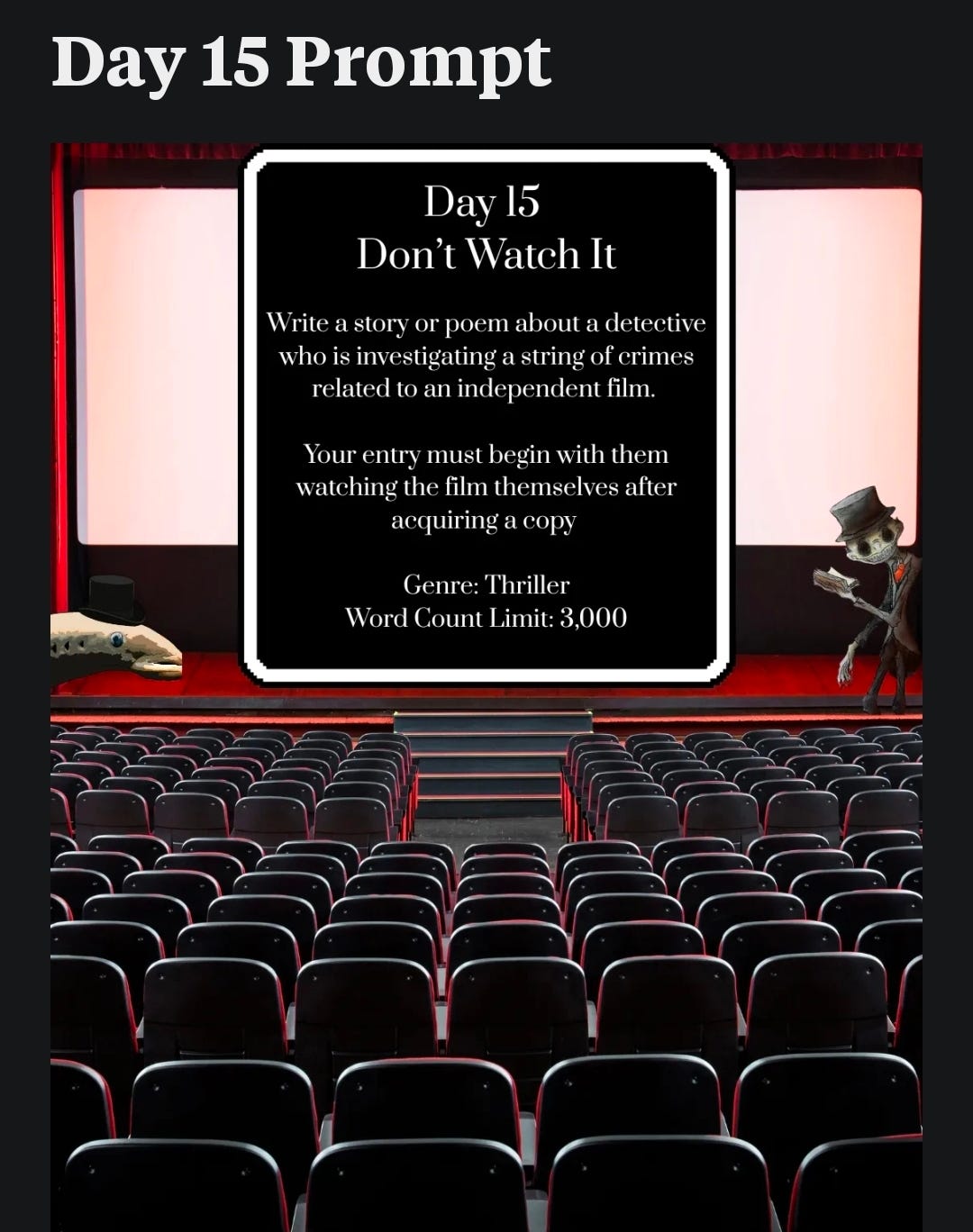
Written for Bradley Ramsey Pandamonium Prompts.
My Creativity is fueled by tea. Lots of tea.
Wow! I loved where you went with this! A metaphysical mystery! So cool!