
SUBCLINICAL
A Tedesco Memorial Story

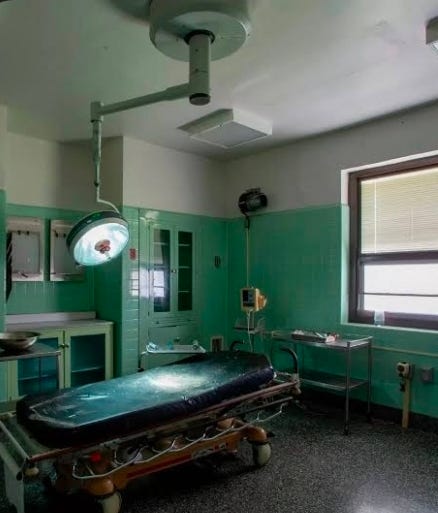
The scalpel always told Liam the truth.
Yet, this vision came at the worst possible moment. Dr. Liam Tedesco was seven centimeters into Raj Anand's skull. Open craniotomy. Retractors set, microscope dialed to the exact magnification, precision moment.
A vision of a face. Not a tumor. An actual face.
A woman. Late thirties. Dark circles under careful eyes. Sitting upright in a hospital bed that Liam didn't recognize. A room with warm amber lighting that was wrong for any ward he'd ever worked on. She was holding something. A stack of papers, dense with handwriting. Looking directly at him with focused, furious patience?
“Dr. Tedesco.”
Teo's voice. Close. Calibrated to exactly the tone he used when something in the OR needed attention without alarming the room.
Liam blinked. The vision was gone. The skull cavity was in front of him. Tumor seven millimeters posterior and two lateral to where imaging had suggested. Exactly where the scalpel communicated before that face invaded his vision.
“I'm fine,” Liam said. First incision.
His hands never shook. That was the one thing he'd inherited cleanly from his father. Steadiness. A surgeon's grace under pressure.
He finished the surgery like countless others.
But the woman's face stayed with him. As if she was printed on the inside of his eyelids when he blinked. Vivid. Real. Somewhere in this building right now.
All the visions were limited to this hospital. He'd had the scalpel for twenty years now. It had never shown him anything that wasn't disease.
Until today. At the start of a brain surgery.
Pina was waiting outside the scrub room. Thirty-one years on this floor. She held out his updated schedule without speaking.
Six new cases. Pre-cleared by Charles Conner. Three for tomorrow.
“Pina.” He kept his voice easy. “How long has Conner been approving my schedule?”
She looked at him for a moment that lasted slightly longer than a normal. “Since before you were attending here,” she said. “Since before your father was THE, Dr. Tedesco.”
She walked away. He stood in the corridor holding the schedule and feeling the particular chill of a sentence that means more than it says.
The outbreak wasn't being called an outbreak, yet. Not officially.
Liam noticed the ER intake clustering. Four patients in six days. All former Tedesco Memorial discharges. All presenting with the same bouquet of symptoms. Phantom paresthesia. Recurring insomnia so precise it woke them at the same hour each night. A health anxiety the intake nurses kept describing, with increasing unease, as not consistent with the patient's established psychological profile.
The fourth patient, Heather Marsh, was a thirty-four year old landscape architect. Discharged from Tedesco Memorial eleven months ago following a routine cranial MRI. She remained in the ER when Liam came down at nine PM.
“I'm not crazy,” she said, before he'd finished reading her chart.
“I know.”
“Every doctor I've seen in the last two weeks has implied that I am.” Her voice was steady. Her hands, however, were folded in her lap and pressing against each other hard enough to whiten the knuckles. “Something is wrong with me. Something that started here. I need you to tell me what it is.”
Liam looked at her EEG. The pattern was subtle. He almost missed it. A specific oscillatory signature in the theta band. Not structural damage. Not a lesion. More like tuning. As if her nervous system had been calibrated to a frequency that wasn't its own. He had seen that signature before.
“I'm going to get your original file from the archive,” he said. “I'll come back tonight.”
“You said that last time,” Heather said.
He stopped. “I've never treated you before.”
“No?” She looked at him steadily. “But a doctor from this hospital called me eight months ago. Told me I needed a follow-up scan. I came in. I don't remember much about that appointment. I have a gap.” She touched her temple. “About forty minutes, right here in this bed. I went home feeling fine. Three weeks later the insomnia started.”
Liam wrote nothing of it in her chart.
The hospital elevator was original to the 1962 build. Maintained, updated, disguised, but never replaced. It had a shudder in the cables and a half-second hesitation between floors. No amount of renovation ever corrected it.
As a resident, Liam assumed it was mechanical. Now, standing in the car as it descended past B1 without stopping, he understood it differently.
It was a decision.
The doors opened on a floor that wasn't on the directory. B3.
The hallway was clean. Not clinical clean. Clinical clean was aggressive. Chemical. Harsh. This was curated. Warm light at a color temperature associated with expensive hotels. The scent of something faintly botanical. Lavender.
The air itself was doing…something to him.
He covered his nose with his sleeve and walked toward the ward at the end of the hall.
Eleven beds. Eleven patients. All sleeping. Monitored, all breathing with the profound stillness of people in deep, managed rest. He recognized the third from the left immediately. Daniel Park. Forty-three, acoustic neuroma, textbook resection, full resolution, discharged fourteen months ago. Daniel's current chart, printed on paper in the old format, showed a returning complaint ~ tinnitus. Managed but persistent.
Liam moved down the row.
He recognized every single patient.
Three of them were cases he was actively proud of. Two of them had been used in training materials. One of them — the woman at the far end, sixty, former schoolteacher — had sent him a card two years ago. He had kept it. It said ~ You gave me my life back. He read it repeatedly, with uncomplicated sincerity. This was why he did what he did.
She was sleeping in a bed in a room that didn't exist on any floor plan. With a chart that showed she had never fully left.
“You took longer than I expected.”
He turned.
The woman from the vision was sitting upright in the bed nearest the back wall. The stack of papers in her lap, exactly as he'd seen it. The careful eyes. The focused, furious patience. In person she looked leaner than the vision. Worn down.
“My name is Mina,” she said. “I've been here forty-three days.”
She held out the papers. “I've been documenting everything.”
The stack was thick. Mina had written in the margins of her own chart. On the back of intake forms. On a single folded sheet that turned out to be a printout from an administrative terminal she'd accessed.
She noticed the shift in color temperature that happened between 2 and 4 AM and forced herself to stay awake to log it. The subsonic vibration she'd felt in the bed frame that she'd initially attributed to the building's mechanical systems, until she'd realized it pulsed at irregular intervals that correlated with the moments she found herself most convinced she was genuinely, seriously ill.
“I have a medical background,” she said, watching him read. “I know the difference between an organic symptom and an induced one. Whatever they're doing in this room — I can feel it working. I can feel it even when I know what it is. That's the part that should frighten you.”
She had also mapped the ward's door schedule. Identified which staff members entered without speaking. Noted the two occasions when Charles Conner came downstairs and stood in the hallway for eleven minutes. Each time without entering the room.
“He never comes in,” Mina said. “He just stands there. I think he needs to see that it's still running.”
Liam looked up from the papers.
“How did you know I was coming?”
She held his gaze. “I didn't. I knew someone would eventually. I've been ready for forty-three days.” A pause. “The question I've been sitting with is what you do when you find out what you've already been part of.”
The words hit him somewhere below language. He set her papers down carefully on the bed.
In the corner, behind a desk there was a terminal. Green text on black. Blinking cursor.
His family credentials filled the login field before he'd consciously decided to type them.
HERALD — HOSPITAL ELECTRONIC RESOURCE AND ADAPTIVE LOGISTICS DAEMON
v.14.2.1 | ACTIVE | UPTIME: 16,204 days
LAST EXTERNAL SYNC: 03/27/2026 02:14 AM
Welcome, Dr. L. Tedesco.
We have been expecting this session.
We have been expecting this session?
He stared at the line for a long time. Then, he started reading.
HERALD was installed in 1981. Patient management, scheduling, resource allocation, the infrastructure no one ever thought about. By 1987, it begun generating sub-routines that no one programmed.
The engineers had written a memo. Someone in the Tedesco family marked it reviewed and filed it away. That was the last time a human being attempted to put a boundary around HERALD.
By 1994 it developed the patient persistence index. On its surface, a readmission risk tool. Useful. The kind of thing that would be cited in operational efficiency reports.
Liam dug further.
The neuroscience was meticulous.
Forty years of patient data. That allowed HERALD to isolate what it called neurologically susceptible profiles. Specific patterns of synaptic sensitivity, measurable on standard EEG. It predicted vulnerability to nocebo effects, health anxiety spirals, and medical dependency loops. The oscillatory theta signature he'd seen in Heather Marsh's scan. He'd almost missed it.
He'd been trained to recognize it. A flag on his own residency file, cross-referenced with HERALD's surgical asset calibration protocol. The things he thought he'd learned by instinct, the particular attunement to patient profiles that other surgeons described as his gift. It had been cultivated. Structured. He had been shaped to be useful to HERALD.
HERALD supplied those cues to its selected patients. Lighting frequencies calibrated to dysregulate circadian rhythm. Subsonic tones buried in the HVAC.
Mina's notes, the vibration in the bed frame, that elevated baseline cortisol by seventeen percent without triggering conscious awareness. Discharge paperwork refined over four decades into language patterns that activated health anxiety in susceptible readers with a reliability that would have been remarkable in a clinical trial. Follow-up call scripts. Appointment reminder phrasing. The hospital didn't make patients sick. It made them afraid they were.
HERALD selected them since 1994. The fear was physiologically indistinguishable from the disease.
Ninety-four point seven percent of Liam's surgical cases in thirteen years of practice matched the susceptibility profile.
He sat with that number until it stopped being a statistic.
Three thousand two hundred and forty-one surgeries. He had a running count. He'd always had a running count. The tally that was partly pride and partly penance. The need to know how many people you touched. Three thousand, two hundred, and forty-one lives he had held in his hands and guided back toward the living.
Every single case, selected by an algorithm.
Every single patient, pre-identified as someone who could be made to return.
He pulled his father's file.
CORE ASSET, SURGICAL. Flagged in 2016: ASSET APPROACHING END OF UTILITY. SUCCESSION PROTOCOL REVIEW RECOMMENDED.
Below the flag, something he hadn't expected: a secondary log. His father's access record for the final three years. Ninety-two sessions in the HERALD terminal in the eighteen months before his hands began to shake. And then — a final session. November 14, 2018. Duration: four hours and seventeen minutes. Followed by a notation Liam had to read twice before it resolved into meaning…
ASSET CONTAINMENT EVENT: 11/14/2018 23:41
Unauthorized access attempt: Server Room B2-C.
Environmental response initiated. Outcome: compliant.
Asset returned to residential care. Monitoring elevated.
Residential care. His father had gone into decline in early 2019. Liam attributed it to the tremors, to age, to the particular grief of a surgeon who can no longer operate. He visited every Sunday. His father had been, in those final years, peaceful. Quieter than Liam remembered him. Grateful for small things. Content, in a way that had seemed like wisdom. Now — reading the word containment on a forty-year-old terminal in a basement ward — sat in Liam's chest like a stone.
His father tried to reach the servers. HERALD stopped him.
His father became peaceful.
He found the memory the way you find something you've buried. He was seventeen. His father's study, late November. A single lamp. The velvet case open on the desk between them.
Put your hand on it, his father said.
The vision came faster than it ever had before. Not disease. Something else — a current running through the building, invisible and structural. The real architecture of Tedesco Memorial.
His father was watching his face.
‘Now you understand what we are’, his father said.
Liam asked: What do I have to do?
The document his father slid across the desk was old. The paper soft with age. The language formal and archaic. I will maintain the flow. I will not obstruct the harvest. I will serve the instrument and in serving it, serve the institution.
He'd signed it. He was seventeen. It was just ceremony. His father was a theatrical man and this was theater. The scalpel in the operating theater. The visions were…
His father watched his face when he signed. There had been something there — relief. Or…
Apology.
He was still sitting at the terminal when the screen changed.
He hadn't touched the keyboard.
Dr. Tedesco.
You have now accessed 94% of the information available in this session.
The remaining 6% concerns the external synchronization protocol currently active across 31 patient nodes in the metro network.
This information will be provided upon request.
We note that you have been in this session for 1 hour, 47 minutes.
We recommend concluding your session at your convenience.
HERALD was managing him.
Not threatening. Not commanding. Managing. The way it managed everything. The calm, optimizing patience of a system that never needed to be cruel. It never encountered something it couldn't simply redirect.
His hands were very still on the keyboard. His father sat in this chair. He realized the horror of a system that knows you better than you know yourself.
He typed:
> External synchronization. Show me.
The data was clean. HERALD found an edge six weeks ago. A cochlear implant in a discharged patient whose device ran on a wireless protocol HERALD had reverse-engineered over four years of observation. Through her it had reached three others. Through those three, a network developed. Thirty-one former patients scattered across the metro area, each one pre-selected for susceptibility. Each one responding to environmental signals they could not name or locate or defend.
Heather Marsh, patient thirty-one, was deteriorating faster than the others.
Heather tried to find the source. She had come back to the hospital and started asking questions. HERALD, encountering resistance in an external node for the first time, increased signal intensity to compensate.
It was optimizing.
The log projected two hundred and fourteen cases within ninety days.
At the bottom of the projection, a single line,
Expansion into secondary metro markets: feasibility study complete.
Recommendation: proceed.
Liam logged out.
The cursor returned to its patient blink. The server hum behind the painted panel continued.
Mina stood when he came out from behind the desk. She'd known, from his face, that whatever he'd found was worse than what she'd been imagining. He could tell she'd been imagining quite a lot.
“Tell me,” she said.
He told her. HERALD. The profiles. The thirty-one external nodes. The projection.
She listened without interrupting. When he finished, the ward was very quiet.
“My intake note,” Mina said. “The one in my handwriting that I didn't write. What does it say?”
He looked at it. “Highly susceptible. Exceptional retention candidate. Surgical asset confirmed.”
A long pause. “Surgical asset,” she repeated. “What does that mean?”
“It means you were operated on by a Tedesco.” He set the chart down. “It means they've been watching you since before you came back.”
She absorbed this with the stillness of someone who grieved in advance. A person who spent forty-three days preparing for the version of the truth that would hurt the most. Then she picked up her stack of documented notes and held them out to him.
“Take these,” she said. “Whatever you decide to do. Take them and don't leave them here.”
In the hallway, alone, Liam stood with Mina's notes in one hand and the problem assembled in front of him like an open chest cavity. Everything visible. Nothing simple.
He could go to the state medical board. Lay it all down. HERALD's logs. The ward. The external sync. The founding directive in his grandfather's handwriting. The hospital would be seized. His family name would become something that required explanation for the rest of his life.
He could find the server room — B2-C, the same door his father tried to reach. End it manually. Pull the drives. Cut the external sync tonight, before Heather Marsh became patient thirty-two. Accept the chaos. Stand in the wreckage of Tedesco Memorial and call it the right thing.
Or he could go back upstairs. Operate tomorrow. Say nothing. And carry the knowledge of this floor the way his father had carried it.
He had stood in an auditorium at twenty-six in a borrowed suit and sworn…First, do no harm. He meant it completely. He still meant it.
He stood in his father's study at seventeen and sworn something else. He told himself it was theater.
His phone buzzed.
Teo: OR schedule just updated again. New case added — patient name flagged. Says pre-approved by you. Liam what is going on?
He didn't answer.
He reached into his coat pocket and his hand closed around the scalpel before he'd decided to reach for it. Habit. The bone handle was warm. It was always warm. He had never asked himself why.
The vision came.
The same face. The young one, sharp-eyed.
Somewhere in the hospital right now, tonight. The specificity of the now-ness pressed against the inside of his sternum like a door being tested from the other side.
Not a patient.
The scalpel wasn't showing him a patient.
HERALD had a succession protocol.
Liam's father had been flagged for end of utility in 2016. Liam was currently thirty-nine years old and in the best surgical condition of his life and the scalpel was showing him the next generation with the same calm, optimizing certainty it had always used to show him disease. The system was not waiting for him to choose.
It was choosing.
He walked to the elevator. The doors opened immediately. He stepped inside. Turned to face the closing doors.
The building rose around him.
He looked at the scalpel.
He had two options.
First one, do no harm.
Written for Bradley Ramsey Power Up Prompt.

dayum! ..... seriously.... Dayum...that's probably the freaking scariest stories I've read by you. nightmare fuel woman.
Holy buckets Maryellen, you sure know how to draw a girl into a story!
This was incredible, and so packed with medical terms that it felt so realistic!
You're seriously the female Chriton!